1 September 2026
Company Liquidation in New Zealand
Information on the company liquidation procedure in NZ. For legal services, and voluntary liquidation in NZ, please contact our lawyers in New Zealand.

Company liquidation in New Zealand commences when a business is no longer able to pay its debts. Our lawyers in New Zealand can assist during this process.
| Quick Facts | |
|---|---|
| Types of company liquidation in New Zealand | Voluntary and compulsory |
Initiating voluntary liquidation | By an agreement among the company’s shareholders – The liquidation decision must be filed with the Companies Office within 20 working days. |
Documents needed for voluntary liquidation | – directors’ declaration, – liquidator consent, – liquidation resolution, – liquidator appointment notice, – call for creditors, – liquidation report, etc. |
| Debt payment requirement | Within 12 months of the liquidator’s appointment |
| Role of liquidator | – performs a company financial analysis, – handles the asset sale and distribution, – interacts with company’s personnel, – files reports with with the Companies Office, etc. |
| Compulsory liquidation – characteristics | Initiated through the High Court on application of the company, a director, a shareholder, a creditor or the Registrar of Companies. |
| Notice for creditors | Must be published in the New Zealand Gazette and a local newspaper. |
| Appointing the liquidator | By the shareholders (for voluntary liquidation), High Court (for compulsory liquidation) |
| Removal of liquidator | By order of the High Court, on application by an interested party (Companies Act 1993). |
| Alternatives to company liquidation | – receivership, – voluntary administration (Part 15A Companies Act 1993), – creditor compromise (Part 14) |
| Distributing the proceeds from the liquidated assets | Following the order of priority |
| Documents for creditors proving their claims | – contracts, – official correspondence, – unpaid invoices, – claim form, etc. |
| Company liquidation duration | 1-2 years (approx.) |
| Regulatory framework for company liquidation | Companies Act 1993 |
| Assistance from our lawyers | Our law firm in New Zealand and our partner accountants manage all the aspects of company liquidation. |
When is liquidation necessary?
The liquidation process is required when a company in New Zealand is no longer able to pay its debts. As such, its assets are liquidated, effectively allowing it to pay its creditors.
The process can vary depending on the company’s activities (i.e., if it is a trading company or not) and its general assets. Our lawyers in New Zealand can give you more details.
Who commences the liquidation process?
Company liquidation in New Zealand can take place voluntarily or via a court order. In the case of the former, the shareholders pass a special resolution through which they decide the next steps, including the appointment of the liquidator (see below).
Liquidation takes effect immediately following the decision to commence the process.
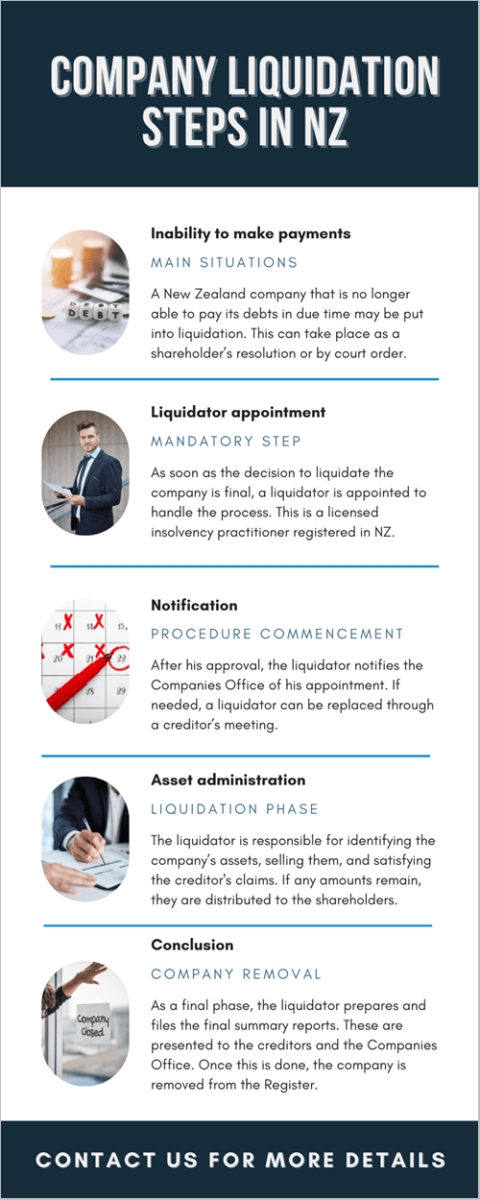
What are the steps for company liquidation in New Zealand?
No matter the type of company liquidation procedure a New Zealand company undergoes, the steps are the same. These are:
- the decision to liquidate: the company is no longer able to pay its creditors; the decision is made by the shareholders or decided by a judge;
- liquidator appointment: a liquidator must be appointed, and he takes charge of the business and assesses all the assets of the company;
- liquidation administration: the company liquidation procedure in NZ starts, and this means that the company can be closed; the final step is to pay the creditors and then divide the remaining assets among the shareholders;
- liquidation completion: the final liquidation report is sent to the creditors; the company will then be removed from the Companies Office Register.
Our team invites you to watch a short video about company liquidation in NZ:

What are the effects of company liquidation in New Zealand?
Once the process is completed, the company is removed from the Companies Register. Our team can give you more details about these effects.
Who appoints the liquidator?
A liquidator is appointed by a special resolution of the shareholders, by the board on an event specified in the constitution, by the creditors at the watershed meeting of a voluntary administration, or by a court order.
Are there any requirements for the liquidator?
Yes. Only a licensed insolvency practitioner can act in this capacity. All licensed professionals are included in the Insolvency Practitioners Register.
What powers does the liquidator have?
They may engage in the following:
- Taking control of all the company’s assets;
- Freeze the unsecured assets and sell them;
- Oversee the payment of the company’s creditors and shareholders;
- Arrange and hold meetings with the creditors (should these be required to address issues related to company liquidation in New Zealand);
- Contact and discuss with key third parties (such as shareholders, employees, solicitors, and others).
What are the duties of a company director during liquidation?
A company’s director is not dismissed during liquidation, but his/ her powers remain limited. He/ she is only permitted to collaborate with the liquidator to facilitate the process and make available any account or records needed for the liquidation.
What requirements apply to companies in liquidation?
Once a company is placed into liquidation, it is no longer required to fill in the annual return.
How long does company liquidation take in New Zealand?
While times vary depending on a company’s assets and its total debts, one could expect a period between three and six months in most cases.
For assistance in winding up a company in NZ, please contact our law firm.